Study spotlight · 2024
Hereditary pancreatitis: one year on a defined protocol
- 151patients enrolled
- 88completed the year
- 98.7%fewer emergency hospitalisations
- 92.8%fewer attacks
Observational study · J Ayurveda Integr Med 2024
 Vaidya Chandra PrakashCancer Research Foundation
Research & development unit of Padaav · Est. 1988
From formulation to evidence
Vaidya Chandra Prakash Cancer Research Foundation, the dedicated research wing of Padaav, has been working towards bringing classical Ayurvedic knowledge into the framework of systematic scientific inquiry since 1988. Its work encompasses clinical research, data generation and analysis, scientific documentation, manuscript development and publication in peer-reviewed journals.
Our approach
Systematic documentation, standardisation of formulations and processes, scientific evaluation of clinical observations, and dissemination of findings through research publications and public outreach.
Our work
Nearly three decades of clinical experience, longitudinal patient data, published studies, treatment outcomes, ongoing experimental research and institutional collaborations.
Explore 02Investigating immune responses through experimental research and clinical trials, with a focus on allergic conditions and immune markers.
Explore 03Developing and evaluating Ayurvedic formulations through process standardisation, quality control and scientific characterisation.
Explore 04Systematic clinical data collection, patient record management, outcome analysis and scientific documentation to support research and publications.
Explore01Flagship programme
Nearly three decades of clinical experience, longitudinal patient data, published studies, treatment outcomes, ongoing experimental research and institutional collaborations.
Study spotlight · 2024
Observational study · J Ayurveda Integr Med 2024
Evaluation/ Validation
A fact-finding committee by Central Council for Research in Ayurvedic Sciences (CCRAS) constituting of Prof H. M. Chandola, Chairperson, SAB, Dehradun, Dr Govind Makharia, Professor, AIIMS, New Delhi and Dr M. M. Sharma, Research Officer (Ay), CCRAS, New Delhi evaluated the treatment records and met some patients in 2017. The committee found prima facie evidences regarding the relief of symptoms in a number of patients. The committee recommended scientific development of the formulation to understand intrigue phenomena behind the stated effects.
Scientific evidence
Experimental studies in animal models have demonstrated pancreatitis-preventive effects of Ayurvedic formulation against L-arginine-induced pancreatitis.
Ongoing projects
 Ongoing
UPES, Dehradun
Since January 2025
GIPMER, New Delhi
Since April 2025
 Ongoing
ACTREC, Navi Mumbai
Since 2023
02Focus area
Investigating immune responses through experimental research and clinical trials, with a focus on allergic conditions and immune markers.
The foundation’s immunomodulatory herbo-mineral formulation, studied in patients and in the laboratory.
IMMBO compared with levocetirizine plus montelukast in a randomised, open-label, active-controlled paediatric study.
GSVM Medical College, KanpurIMMBO’s immunomodulatory, anti-inflammatory and mast-cell-stabilising activity, studied in animal models.
Vipragen Biosciences, MysuruHeld with UPES as part of the joint research and seminar programme.
UPES, Dehradun

03Focus area
Developing and evaluating Ayurvedic formulations through process standardisation, quality control and scientific characterisation.
Vaidya Chandra Prakash learned Rasa Shastra from his guru. His formulations, including Amar, a preparation made of processed copper, mercury and sulphur, are the starting point of our pharmaceutical work.
Authenticated raw materials, written operating procedures, batch records and batch-to-batch reproducibility.
Characterisation and standardisation in the Inorganic and Physical Chemistry department.
Indian Institute of Science, BengaluruAcute and sub-acute toxicity studies of Amar and IMMBO.
Vipragen Biosciences, Mysuru
04Focus area
Systematic clinical data collection, patient record management, outcome analysis and scientific documentation to support research and publications.
Our clinical base is Padaav Speciality Ayurvedic Treatment Centre in Udham Singh Nagar. Every admitted patient is registered, charted and followed up on a fixed schedule, so that a case can be read by a clinician who was never in the room.
Other research
Haematology
A metal-based formulation for APML, building on a documented paediatric remission at AIIMS, New Delhi.
Neurology
Clinical and pharmacological evaluation of an Ayurvedic protocol for migraine, including a clinical trial series of 204 patients.
Hepatology & nutrition
A comparison of Punarnava Mandoor brands, and a pilot of a non-iron preparation in 600 anaemic women.
Open to collaboration
“We don’t make claims. We research.”
Research Partners
Our formulations and research findings are open to independent evaluation and validation. We collaborate with academic and scientific institutions to characterise formulations, investigate their effects and strengthen the evidence through rigorous testing. We welcome partnerships in areas such as inflammation, pancreatic disease, metal-based medicines and clinical research.
Inorganic & Physical Chemistry. Standardisation of Amar and Mandoor Bhasma.
Neurology and Pharmacology. Ayurvedic migraine protocol.
Joint research, seminars and the Amar pancreatitis project.
Interdisciplinary studies in pancreatitis.
Kanpur, Paediatrics. IMMBO in allergic rhinitis.
Mysuru. Animal-model studies of Amar and IMMBO.
Hepatoprotective comparison of Punarnava Mandoor brands.
Metal-based formulation for acute promyelocytic leukaemia.
Department of Gastroenterology. In vitro and translational research in pancreatitis.
Tata Memorial Centre. Role of AMAR in pancreatic cell lines and serum biomarkers in pancreatitis.
Universities, medical colleges and research laboratories working on inflammation, pancreatic disease, metal-based medicines or clinical research can write to us.
Get in touchPublications
Prakash VB, Prakash S, Negi N, Sati ST
Journal of Ayurveda and Integrative Medicine · 15(3):100913
Prakash VB, Prakash S, Negi N, Sati ST
Journal of the Epidemiology Foundation of India · Jan–Mar 2025 · 3(1)
Prakash VB, Prakash S, Sharma S, Tiwari S
Pancreatic Disorders & Therapy · 8:196 · doi:10.4172/2165-7092.1000196
Prakash VB, Prakash S, Sharma S, Tiwari S
Pancreatic Disorders & Therapy · Conference abstract, Philadelphia
Prakash B
International Journal of Ayurveda Research · 2(1):56–59
Prakash B, Parikh PM, Pal SK
Journal of Ayurveda and Integrative Medicine · 1(3):215–218

Our namesake
Born on 6 January 1919 in Chhabadiya village near Sardhana, Meerut, the sixth child of Lala Nandlal. A Rasa Shastra vaidya whose cases set the foundation its central task.
Trained from boyhood under his guru, Ayurvedacharya Shri Krishnadev Chaitanya Parashar ‘Yayavar Rishi’. Prabhakar, University of the Panjab, Lahore, 1940, and a vaidya degree in Lahore.
Niloha, Meerut, from 1942, then Muzaffarpur, Bihar, where he was registered as a vaidya in 1956. From 1958 he practised in Meerut until his death on 13 December 1984.
Married Shashi Mukhi, daughter of the Bihar Khadi leader Lakshmi Narayan Agrawal, in 1945. Corresponded with Dr Rajendra Prasad; Jayaprakash Narayan wrote that he had been his patient.
His cancer cases drew two government fact-finding reviews, the second by a committee of the Central Council for Research in Ayurveda and Siddha. But he could not always reproduce the medicines that had worked: there were no written procedures for preparing them and no structured record of how each patient responded. When his son, Vaidya Balendu Prakash, set up the foundation in 1988 in his memory, closing that gap became its purpose: standardise the preparation, document every patient, and publish.
“गीदड़ों को जिमाते रहो, एक दिन शेर भी जीमेंगे”
Remembered by
“He never worked for money or fame. He was a researcher, for the world of Ayurveda.”
“I know Shri Chandra Prakash well. He is a capable and experienced vaidya.”
“Cooling like the vast shade of a banyan, the very image of patience.”
From the archive · January 2020
Written and Compiled by Megha Prakash
Account as narrated by Vaidya Balendu Prakash
A centenary tribute to Vaidya Chandra Prakash, published by the foundation in 2020. In Hindi, it gathers his life as told by his son Vaidya Balendu Prakash, letters from his guru, his certificates, letters from Dr Rajendra Prasad, press coverage of his cancer work, and memories from twenty family members, friends and neighbours.
Legacy
From one physician’s results that could not be repeated, to a foundation with university partners, a clinical centre and peer-reviewed papers.
First generation · Namesake
A Rasa Shastra vaidya in Muzaffarpur and Meerut, trained by his guru from boyhood. His work with cancer patients gave the foundation its purpose.
Second generation · Founder
Founded the foundation in 1988 and built its clinical documentation, research partnerships and facilities. Honorary Physician to the President of India, 1997–2000.
Third generation · Director – Research / Managing Trustee
Leads clinical work at Padaav and co-authors the foundation’s pancreatitis research.
The archive · 1919 to today
People who stand by us
Leaders from medicine, industry and public life who have followed the work of Vaidya Chandra Prakash and the foundation over the years.

More than 50 years ago, VCP was conceptualized for a rather different kind of research — not to find new cures & new medicines, but to ensure that an ancient medical science did not disappear. The traditional methodology & processes written down for the medicines required years just to complete the making of one batch. The decision taken was not to question the process but ensure its sustainable replicability batch after batch since each takes years.
The first task was to use modern scientific methods to standardise, validate and meticulously document processes that ancient texts prescribed. There was deep conviction on the science.
We believed that before the needed trials to further test the efficacy of a medicine, we had to first ensure that it could be made consistently, preserving the science for generations to come. An unusual mission but amazingly fulfilled despite trials, tribulations and almost negligible support for the first 20 years. The VCP by line should perhaps be “Research through honest Resilience”.

Ayurveda means the ‘Science of life’ in Sanskrit and is a traditional holistic system of Medicine with roots in ancient Vedic culture and is about 5000 years old. The aim of this system is to prevent illness, heal the sick and preserve life. Ayurveda originated in India but has now spread across the World.
Ayurveda was taught in Gurukula system in ancient days and has now evolved, and is being taught in undergraduate and post graduate courses. Unfortunately, the knowledge of this Science was passed on from father to son and there is absence of authentic scientific data to corroborate the findings and with the rise of scientific temperament, the need is now being felt to document and authenticate all findings and research.
Vaidya Chandra Prakash Cancer Research Foundation established in 1988 in Uttarakhand, is one such Institute which is doing great service in the research and Validation of Ayurveda specially in the field of Cancer. It is primarily focusing on bringing traditional Ayurvedic wisdom with modern scientific and clinical documentation.
I extend my best wishes for the exemplary work being done by the Institute and wish it reaches great heights in the years to come and keeps on serving the people.
Community work
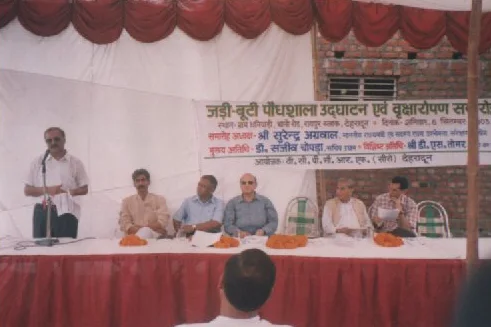
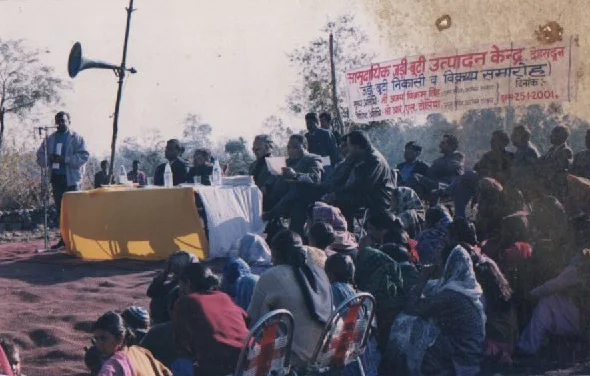
From medicinal herb cultivation to cancer awareness walks and fundraising concerts, the foundation has worked with communities since 1992.
Medicinal plants
Herb nurseries, training in herb cultivation, and the distribution of herbs and saplings, with the community herb production centre in Dehradun.
Cancer awareness
Public walks that bring students, families and supporters together to talk about cancer.
Fundraising
Concerts and events that raise funds for the foundation’s research, beginning with “Shuruaat”, a concert by ghazal maestro Jagjit Singh.
Training & Capacity Building
Building upon our legacy of clinical excellence and rigorous education—inspired by pioneering initiatives like the I3CAP (Individual, Institute and Industry: “Confident Ayurveda Practitioners”) project—the Vaidya Chandra Prakash Cancer Research Foundation is deeply committed to mentoring the next generation of physicians.
We believe that true mastery in Ayurveda requires a seamless bridge between classical wisdom and hands-on clinical mastery. To achieve this, we offer structured training programs and workshops designed to cultivate skilled practitioners capable of handling complex clinical landscapes with confidence.
“Dissemination of traditional knowledge is essential to keep Ayurveda alive and ensure it reaches the right hands.”
Key Training & Educational Initiatives
01

02
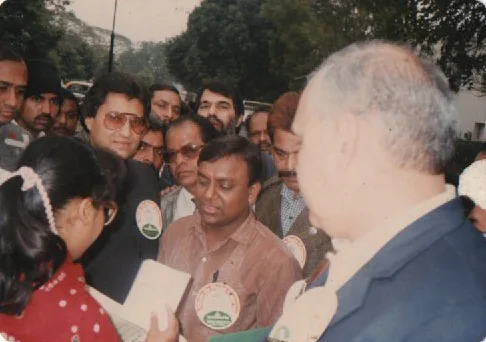
Continuing our tradition of practical education—marked by milestones like the National Training Workshop on Rasa Shastra (NTWRS) held in 2004—we conduct periodic, hands-on training workshops focusing on the authentic pharmaceutical processing, purification (Shodhana), and safety of classical herbo-mineral preparations (Bhasmas).
National Training Workshop on Ras-Shastra, Indian Institute of Petroleum, Dehradun, October 2004

Bridging evidence, innovation and integrative care. Clinicians, researchers and patients meet to compare what is known about pancreatitis across systems of medicine.


